

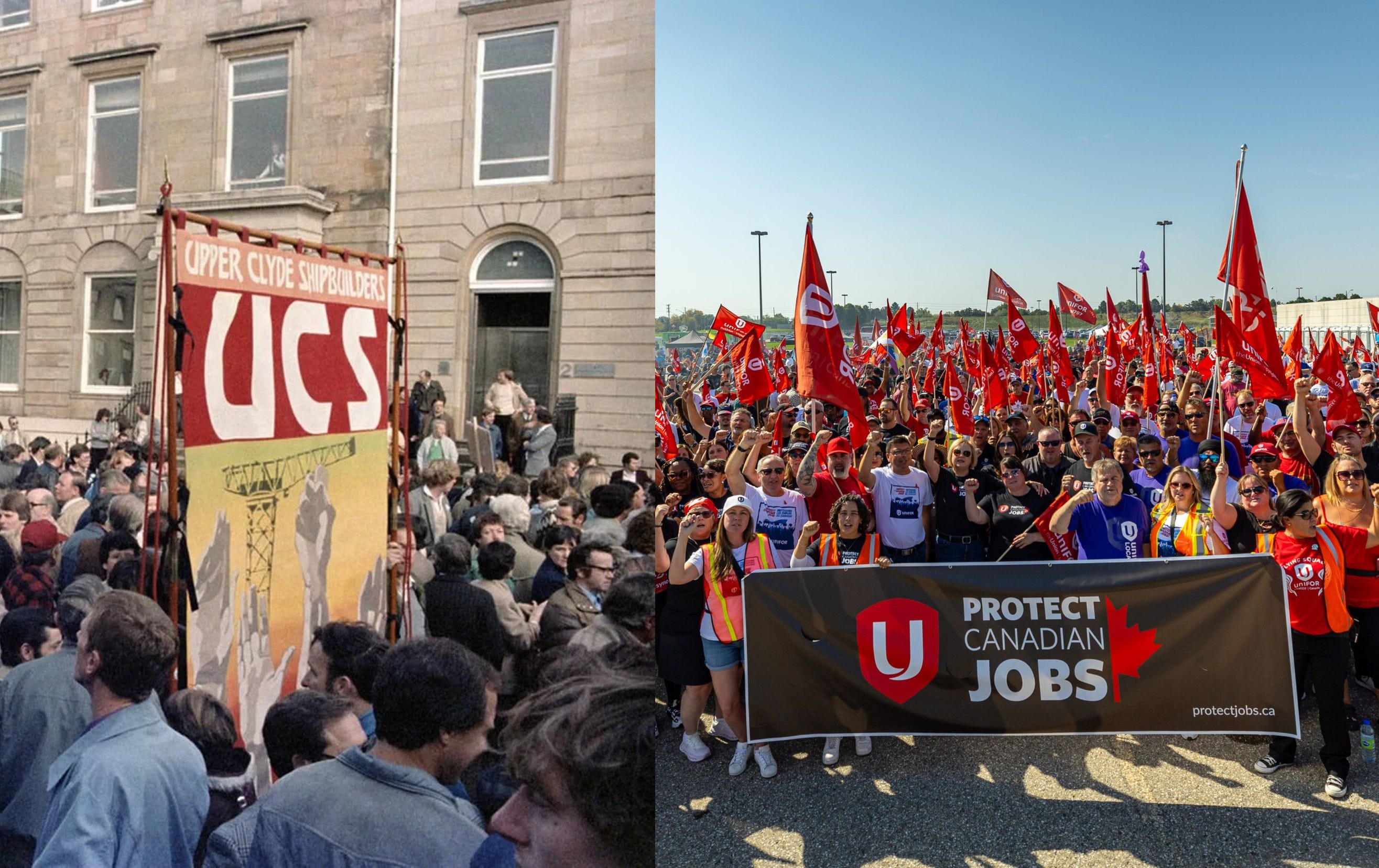
This is Part 2 of 3 of a series looking at Scotland’s past to offer insights for Canada today as we face economic turmoil. Read Part 1 to get caught up on what happened in Scotland in the 1980s, including the economic and policy environment and its impacts.
Scotland’s experience of an economic and political crisis in the eighties is not a relic of the past. It is a living example of what happens when an economic shock collides with policy choices that put people and places in very difficult circumstances. We can see echoes of that experience in parts of Canada today. Let’s look at those striking similarities, acknowledge and understand the differences, and analyze the risks based on the experience of both places. This can help us understand how to avoid a difficult path and how to develop solutions that can mitigate the challenges we face.
How does Scotland’s past compare to Canada today?
Canada in 2025 is not Scotland in 1982. You are not going to find a sausage roll here for 10 p. Important aside: that’s about 10 cents. Further aside: a sausage roll is also exactly what you would imagine. It’s a less than heart healthy snack featuring a hot sausage (not spicy hot, temperature hot) wrapped in buttery, flaky pastry.
Those important items aside, there are still many similarities. Let’s take a look at them:
High inflationary period: Scotland faced historically high rates of inflation in the mid-seventies, still reaching double digits in the early eighties (12-18% in 1980-81). Although not at those levels, Canada experienced very high rates of inflation in 2022-23 that have only just begun to stabilize. The speed and scale of inflation shock was lower in Canada, but household-level pain has been significantly higher given debt loads and housing costs that were not as acute in Scotland. This draws the inflationary experience closer together than it may appear at first glance.
Accelerating de-industrialization and decline in manufacturing employment: Scotland experienced accelerated de-industrialization in the eighties, with 650,000 employed in the mid-seventies to 191,000 today. Canada has faced a similar decline in manufacturing employment for decades, having peaked at 2.2 million people and a 15 per cent share of the labour force in 2000, down to 1.8 million people and less than 9 per cent of the labour force today. While decline has been slower and the troughs lower in Canada, there is a measurable decline. High unemployment rates have also been persistent and acute in many communities such as Windsor, Kamloops, Oshawa, Kelowna, and other communities. Further, short-term trade pressure is already impacting employment, and rapid technological change could severely disrupt employment.
Profitability and productivity challenges: Like Scotland in the early eighties, heavy industries and manufacturing in Canada struggle with productivity and profitability. This is undoubtedly a feature of our current economic paradigm that seeks low cost providers, and is further threatened by trade wars. Canada today also faces unique pressures from automation and AI that could displace workers rapidly. This is a risk Scotland did not face in the 1980s, but is potentially equal in scope, speed and scale to the manufacturing transition from the Global North to the Global South that accelerated in the eighties.
Smaller partner in a highly integrated economy: Canada is a smaller partner in a highly integrated economy with the United States (and Mexico). Scotland was (and is) a smaller partner in an integrated economy with England (alongside Northern Ireland and Wales).
Resource focus as a saviour: There were many who saw North Sea oil revenue as a potential saviour, as others see universal benefit to aggressive ramp up of fossil fuel extraction in Canada. Yes, there can be some known economic benefits, but they may not be as great or as universal in terms of real employment impact and total economic impact. There is limited evidence that North Sea oil had a material impact on employment (particularly), and it only had a modest impact on GDP growth.
Regional concentration of pain. Scotland’s unemployment spike and closures saw deep place-based scarring in West-Central Scotland along the River Clyde and across the Central Belt. Canada’s risk (and historical pain) is concentrated in the auto, metal and industrial manufacturing corridors of Ontario and Quebec along the 401 and Autoroute 20/40 corridors. Of course, not forgetting Hamilton, Sherbrooke or Saguenay-Lac-Saint-Jean nor can we forget hubs like Prince George, BC’s Lower Mainland, Edmonton, Halifax or other manufacturing centres. In many Canadian communities today already hit by deindustrialization, we also face a legacy of poverty and deprivation. My family’s current hometown of Hamilton in Canada has faced that challenge for decades, with some progress made particularly in reducing child poverty.
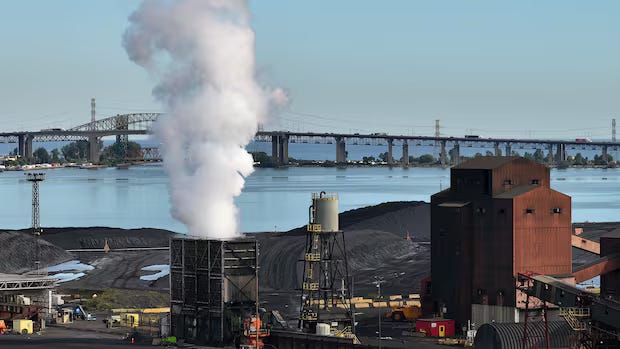
Derelict sites and transition legacies. Scotland’s deindustrialisation left a long tail of derelict land. It has made great strides in reducing that environmental and community burden over the past decade. Canada has a similar environmental challenge, and could face further brownfield legacies around downsized, delayed or shuttered projects or companies. Canada’s municipalities are particularly vulnerable as they hold most of the liability but have the least fiscal firepower to manage transition or remediation.
Separatist and populist movements. In both Scotland and Canada, there is a very open and ongoing discussion about separation driven by economic, cultural and political factors. And although not a feature of Scotland’s past, the newest feature we are all navigating is the rise of populist movements that can find fertile ground in the communities that are left behind. Reform UK has now overtaken Labour as the second most popular party in Scotland.

Differences
Beyond these similarities, there are certainly many differences between Scotland’s past and Canada in the present:
Financial Capital: Canada sits on enormous financial wealth amongst individuals and institutions in the country, including our pension funds and financial institutions. Our pension funds alone hold $2.5 trillion in assets. An estimate for Scotland in 1982 would be roughly $160 billion in capital based on inflation and a proportional estimate of the nation’s wealth in comparison to the rest of the UK. Canada also has protective financial infrastructure including community finance institutions and modern Crown Corporations that did not exist in Scotland at the time as bulwarks against economic shock.
Natural Capital: Canada has tremendous natural capital and resources, from the biodiversity of the Boreal Forest and Carolinian region to a range of critical and rare earth minerals. This natural capital far outweighs the resource base of almost any country on earth.
Population: Canada has a much larger population base with business and cultural connections to markets around the world. For reference, Canada’s population today is 41 million and Scotland had about 5 million people in 1982. The rapid rise in population without sufficient and appropriate policy interventions to build more affordable and appropriate housing has caused a crisis for many families and communities today. Further, this rapid population growth has caused infrastructure strain and labour market mismatches (eg. lower wage work for highly educated, and highly skilled individuals).
Manufacturing Industry: In Canada, we don’t have nationalized manufacturing industries, and manufacturing represents a lower portion of overall employment in a more diversified economy. Although the risk is still great and potentially very painful, it is proportionally lower. On the other hand, many communities in Canada are faced with the long tail of manufacturing decline for decades, and they are still struggling for a path to recovery.
Financial Services: Following deregulation (Big Bang in the UK and many other parts of the world), financial services represent a much larger share of the economy. Its economic impact and role has roughly doubled in both countries.
Polycrisis: In the West in the early eighties, existential economic, environmental and technological crises (beyond the nuclear threat) were mostly found in the fictional realm of Huxley, Orwell, Carson, and Asimov. Today, we face complex polycrises including climate, biodiversity, trade wars, disruptive economic transition due to AI, and inequality. We struggle to agree on the problems and solutions and to achieve progress in tackling these crises.
Political environment: The political environment of Scotland in the late eighties was coloured by the Cold War and the battle of communism versus democracy. Our political environment today is wrestling with populism and even the belief in the current democratic state. A recent Ipsos survey analyzing perceptions of democracy reported lower than 50% satisfaction in eight (8) of (9) western democracies. Connected to the above, a polarized political environment with growing discontentment with democracy also makes it more challenging to achieve a national consensus on how we approach our greatest challenges.
It is important to note that these differences do not necessarily place Canada solely in a stronger position. Yes, we have significant protections, infrastructure and assets. But there are clearly greater levels of complexity and different challenges that create different pressures.
Risks
The experience of Scotland and knowledge of the current Canadian political and economic environment allows us to understand potential risks:
Trade war and tariff shock: Broad US tariffs on metals and autos are causing pain in loss of employment and pressure on government treasuries for relief. A tighter auto Rules of Origin interpretation or frequent audits can slow cross-border flows. The trade war is not limited to these fronts: canola farmers and timber enterprises are also feeling this pain.
Tri-national breakdown. If CUSMA’s 2026 review morphs into a prolonged standoff and Mexico’s integration is materially impaired, North America’s cost base rises and investment defers. We could also lose preferred, low cost access to the world’s largest market.
Auto manufacturing movement: Our anchor industries are under tremendous pressure. America is aggressively seeking to move manufacturing stateside. We risk being a branch plant to America where we may manufacture some parts, but no cars. We are already seeing movement of manufacturing by businesses like Stellantis who decided to move the production of the Jeep Compass from Brampton to Illinois.
EV and battery transition. Our long-term arc requires us to transition to a decarbonized economy. Many countries are making incredible strides in this way from China to Germany. One of those paths in a car-loving world is EVs. And I love EVs. Unfortunately, not everyone does. And like many new industries, it takes a long time and many failures for a sector to successfully get to scale. What if one or two flagship EV or battery projects slip materially in terms of financing, timelines, tariff mitigation strategies, or their underlying profitability? We have seen high profile failures from Northvolt to Lion Electric to Li-Cycle. Further, what happens if EVs uptake slows as we pursue a more carbon intensive path? Canada’s signaling a movement back towards oil and gas may decrease the value and potential of our investments in EV manufacturing.
Broader economic transition: While we manage trade wars and challenges in the auto sector, we are also facing a potentially disruptive scenario for workers caused by AI and automation. This could simultaneously impact white collar and blue collar jobs, causing an employment shock scenario we are not necessarily prepared for in Canada. We have seen some signals with AI related job cuts at Inuit in Edmonton and OpenText in Waterloo, alongside reductions and hiring slowdowns at distribution centres and manufacturing facilities due to automation in grocery and retail.
Place-based pain: We will feel greater economic and social pain in certain places if we are hit with the full force of an economic transition. In Canada, we have a significant concentration of manufacturing in certain regions. Localized jobless spikes are plausible even if the national rate drifts up only gradually. Further, in Canada today, like Scotland in the eighties, there are already many communities feeling pain and left behind by mill and factory closures.
“Big bet” strategy: Canada’s strategy is currently very focused on big bets on nation-building projects. The UK made a big bet on a crash reset, privatization, and market orthodoxy coupled with some small, scattered bets. Large and small bets failed Scotland in the short term. In Canada, major nation-building projects are a necessary but insufficient condition to manage through this challenging moment. In order to engage in economic nation building, you must bet on thousands of SMEs, women and communities from coast-to-coast-to-coast. In this way, we need to also ensure we invest in community building projects across the country to reach scale.
Focus on resources: If we look at our major projects, Canada appears to be returning to natural resource extraction and management as an economic priority. Although there are opportunities and benefits in this broader sector, they can be short-term and uncertain. We lose out on the broader and longer term benefits of value added manufacturing as an anchor of our economy.
Single man strategy: From the outside, it seems we are currently operating under a primarily single man, CEO-style strategy that is very focused on political top-to-top trading and political relationships. To a certain extent, there is political necessity to this strategy, and it seems we have the ideal person for this job. But it is insufficient to meet the challenge of the moment and highly risky to rely upon a single person to save the day. It is much more prudent to have an approach that engages a wider swatch of business, civil society, labour, Indigenous and other partners.
Education and retraining: Education and retraining is critical during a period of economic crisis and transition. Youth unemployment is already far above the average, and it has been highly volatile over the past five (5) years. It is also very difficult for individuals to transition from manufacturing into other careers without support, pathways and retraining. If we miss on education, retraining and creating opportunities for both young people and those who have lost their jobs at mid-career, we face compounding economic, social, and political challenges. In general, Canada’s current systems offer better training infrastructure than Scotland had, but they are underfunded and require significant modernization to respond to the challenges of today. In a world where we are focused on major projects, we often forget that our greatest project is to educate, prepare and retrain our fellow citizens to ensure individual and collective prosperity.

Now I am not raising the alarm about an immediate and utter catastrophe. But taken together, these risks are not abstract. And if not addressed, all of the similarities, risks and even some of the differences outlined above represent potential drivers for Canada to drift into its own version of Scotland’s experience: sudden shocks, place-based pain and long-term scars, and political backlash. That is not inevitable. It depends on what we choose to do next.
In the third and final part of the series, I will look more fully at what Canada could do based on the experience in Scotland (and our own experience). Comments and questions welcome.