

I am a child of the last days of Scotland’s Industrial Revolution.
My father worked at Ravenscraig Works in the late seventies and early eighties when I was born. It was located in the broader Glasgow and Clyde region that had been the home for iron and steelmaking since the 18th century.
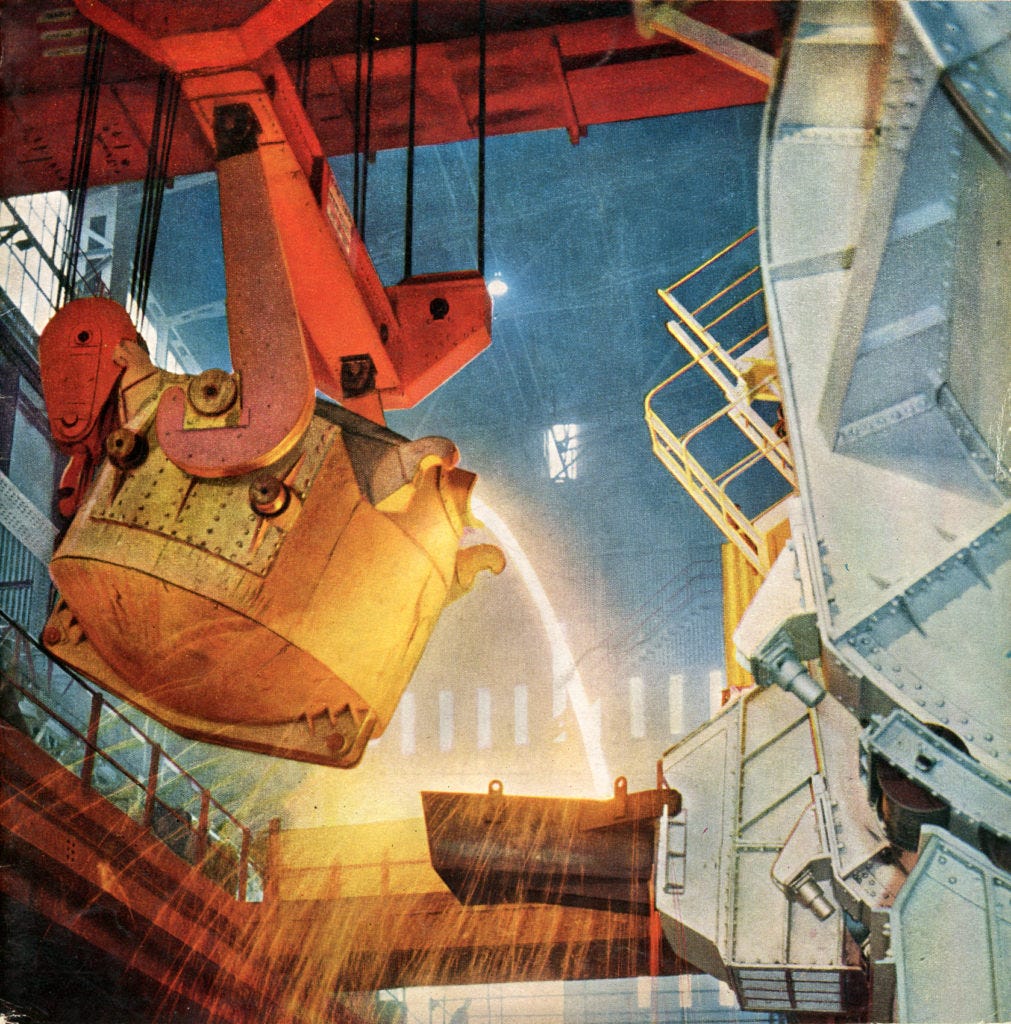
Ravenscraig was the largest hot strip steel mill in Western Europe stretching across a wide swath of North Lanarkshire, Scotland. At 1,200 acres, the sprawling site was larger than Central Park, Monaco, Disneyland, and the Toronto Islands. Although the scale is hard to comprehend, it is easy to paint a picture of this monumental place.
There were massive blast furnaces plated in grey steel, matte black hot coke ovens, cauldron-like ladles of hot glowing metal, orange rivers of liquid steel flowing through the shop floor, and giant slabs of metal each weighing more than a fully loaded city bus that would be rolled into neat metallic coils. There were thousands of workers humming in this steely hive working around the clock. The community that surrounded it was proudly known as Steelopolis.
Alongside many businesses in a heavily industrialized economy, it was the beating heart of the economy and community in Motherwell, Glasgow, and the rest of Scotland.
In the early eighties, the mill, the community and the economy that surrounded it was in crisis.
Job cuts. Calls for closure. Labour action. The writing was on the wall. So we left.
My parents looked at many places, from England to Zimbabwe. But Canada seemed like the right fit. My father got a job offer in Regina and accepted. So we took all of our woolen coats, sweaters, and mitts and headed off into the Great White North. Now, let’s not be dramatic. I wasn’t escaping conflict or civil strife. It was all relatively orderly and similar to any economic migration today. We got on a plane in November 1982, and in a few hours we arrived in Canada to start a new life. We settled in Canada, I became a citizen at six (6) years old, and I’ve lived a great life as a Canadian in the country that adopted me.
I’ve been back to Scotland a handful of times. I never visited the mill. But I feel its long, dark shadow, particularly during periods of economic crisis. There are echoes of that past in our current moment. We are in the midst of a potentially painful political and economic transition. There are job cuts, slowdowns, and flashing red risks across the country.
I wanted to share its broader cautionary tale so we don’t take the same path in Canada while in the midst of an economic shock, and while we seek national solutions. Let’s take a look at what happened in Scotland, including the economic and policy environment and its impacts. We can then examine the similarities and differences with Canada (and Ontario), as well as the risks. And ultimately, we can ask the question: what does the story of Scotland in the early eighties and beyond tell us about what we should do in Canada to ensure we have a just transition? I will seek to answer these questions in this in a three part series, starting with Scotland’s experience.
What happened in Scotland?
Economic environment
In 1970, Scotland’s economy was anchored in heavy industry that was built with pride by generations of workers: coal mines, steel mills, shipbuilding yards, and textile factories. Over the following two decades, the country was hammered by global economic forces, rapid deindustrialization, and unemployment.
A global economic downturn, severe inflation, the 1979 energy shock, and economic policy by the national government contributed to a deep recession in the early 1980s. Manufacturing job losses were severe and concentrated. Scotland lost 37 per cent of its manufacturing jobs between 1971 and 1981, mostly in the last four years. Overall unemployment doubled in the late 1970s and early 1980s, reaching a 14% unemployment rate by the mid-eighties (or 400,000 citizens). Unemployment hit youth particularly hard: in 1983, over a third of males aged 18 - 24 were out of work in the last 12 months, a rate twice as high as their older counterparts.
North Sea oil did surge in the same era. But there is limited evidence that North Sea oil had a material impact on employment (particularly), and it had a modest impact on GDP growth. The sector was capital intensive and could not offset industrial job losses, with only four (4) per cent of Scottish employment in the mid-1980s in oil-related jobs.
Ravenscraig was indicative of the trend. Although not officially closed until 1992, they experienced disruption and decline throughout the eighties with closures, labour action, and continual threats of shutdown.
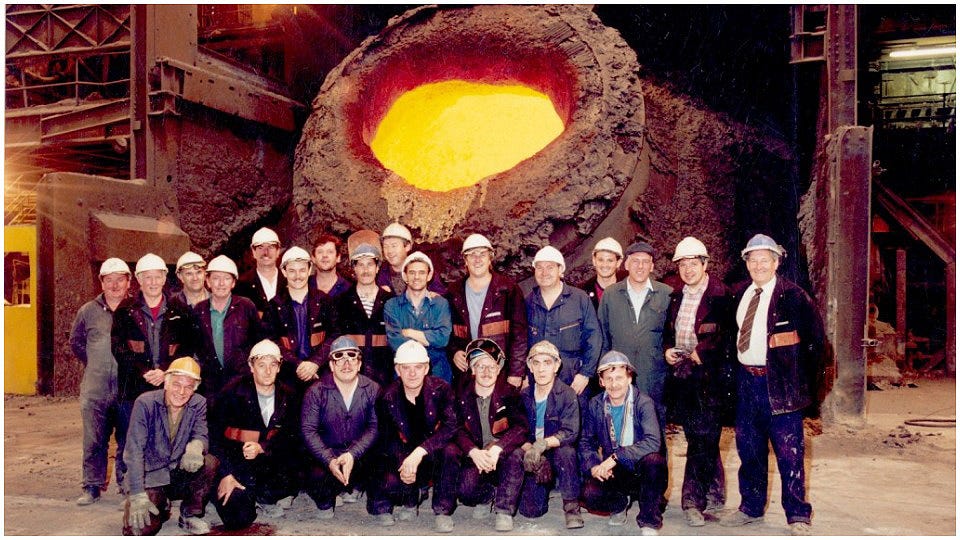
Employment in the mill had peaked at 12,000 workers. By 1982, employment had declined to 4,173 hardy souls. In 1980, the Chairman of British Steel recommended the closure of Ravenscraig, followed by protests. It did remain open, but a pay and productivity scheme followed, leading to labour strife in March 1982 that again threatened closure. The slab mill was closed in December 1982, with the loss of 700 jobs. A decade later, the cooling towers came down and Ravenscraig was closed.
Today, it is a windswept park and brownfield site awaiting redevelopment.
In sum (aka TLDR), industry cratered resulting in mass job loss. Youth were hit particularly hard with higher rates of unemployment.
Political Environment
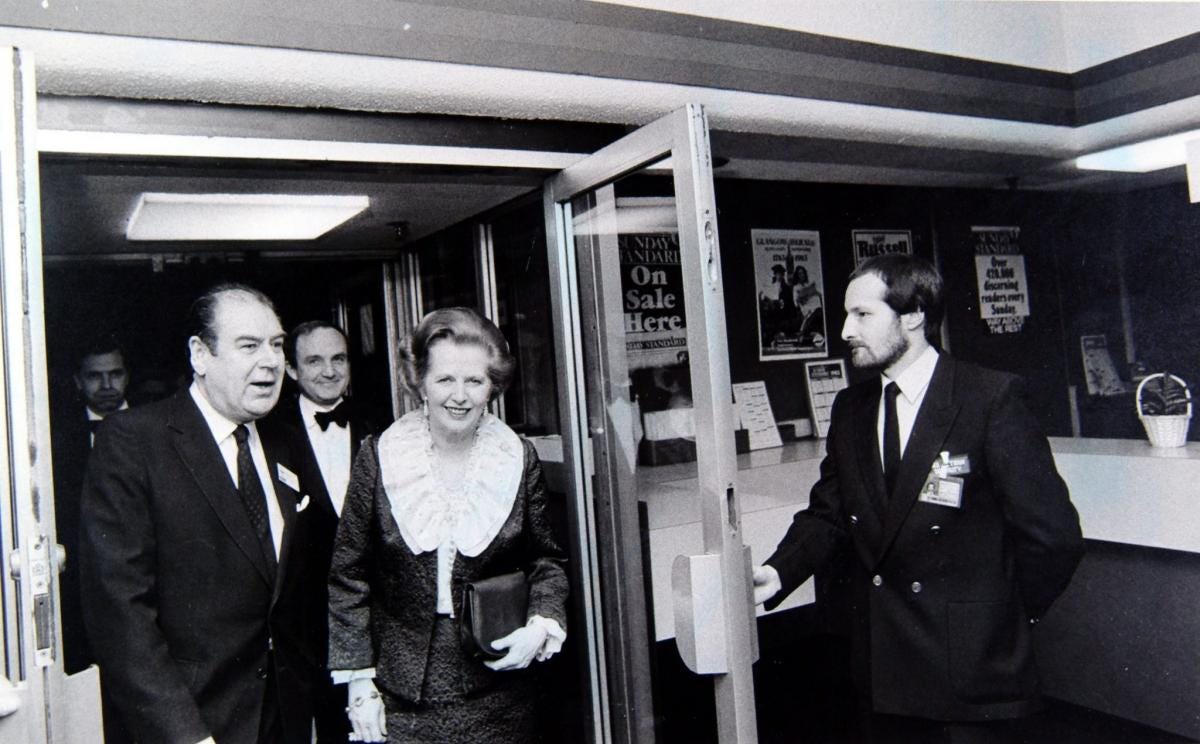
Margaret Thatcher was elected Prime Minister of the UK in May 1979. She had a powerful personal narrative and a sharp policy message. The Grocer’s Daughter who would become the Iron Lady had five simple tasks for the nation: restore economic balance, achieve prosperity, support rule of law, help families, and strengthen defence. Amongst many things, this meant severe reductions to the government budget and money supply, trade union reform (or labour crackdown depending on your view), cutting taxes, and increasing defence spending. It also meant shuttering and privatizing large national industries that were experiencing low productivity and financial losses.
It was a mathematical and political choice.
The Thatcher government chose to prioritize defeating inflation, the sweet and purifying forces of the market, and the movement towards eliminating subsidies to loss making industries. They also chose to accept heavy job losses to “right size” steel, coal, shipbuilding and other national industries rather than find other solutions to keep them open. The known result of the strategy: a very hard landing for workers, local businesses, and their communities.
Let’s be clear. The economics of steel and other industries were not great. Between 1967 and 1980, grants and loans to British Steel alone amounted to £4.9 billion, and they experienced losses of £1.5 billion during that same time frame. At the time, they were also nationalized industries, which is generally a novel concept to us today. There is a much longer discussion for smarter folks on that topic, but the hot take is this: it wasn’t going to work as a nationalized industry, but letting it collapse in the name of Adam Smith and sound fiscal management was also not the right thing to do.
The framing was that there was no alternative. But there were certainly more that could have been done. And arguably, it was a false choice: there were options beyond letting it fail or continuing to shovel money into the blast furnace.
Now, we also cannot say that Thatcher did nothing. There were some programs and policy responses. But they were very light touch relative to the shock-and-awe economic policies. They also did not prevent deep scarring and impacts in communities and across the country. And they had limited results.
There were national training and retraining programs. But the scale, quality and impacts were uneven. The Youth Training Scheme was launched in 1983 and enrolled hundreds of thousands. But evaluations from the University of Nottingham, Princeton University, and others found low quality training and patchy outcomes including low wages and limited pathways to durable jobs.
There were also some place-based programs and incentives. But again, there were mixed results. Enterprise Zones and regional aids alongside the pre-existing Scottish Development Agency (SDA) tried to backfill jobs and attract inward investment into areas like the “Silicon Glen.” The Enterprize Zones offered incentives and benefits for target regions, but evidence showed that there was high displacement (eg. jobs just moved from one place to another) and modest job creation with limited bang-for-the-buck on cost-per-job. Communities still experienced closures and job creation did not offset the collapse of coal, steel, and shipbuilding.
The effort to court electronics manufacturers (eg. Silicon Glen) created real employment and benefits, but the branch plant model was fragile and unsustainable as these businesses and factories also eventually closed.
The bottom line: the Thatcher government let uncompetitive industries fail with the aim of restoring profitability and curbing inflation while accepting heavy job losses. And the policy responses were wholly insufficient to respond to the speed and scale of accelerated de-industrialization.
As a result, some people chose to leave. In that way, I am also a child of Thatcher.
So then what was the impact in Scotland?
You may have seen the movie Trainspotting (or its sequel) and thought: this is cool. Yes, great movie. But also not cool. It was a cultural snapshot of the country in the late eighties after this economic crisis hit with full force. There were significant social, economic, environmental, and political impacts of the painful economic shock that took place in the eighties.
Social
Sudden, regionally concentrated job loss in steel, shipbuilding, coal;
Long spells of male unemployment and higher incapacity benefit reliance;
Weakened union power;
Community identity loss;
Out-migration of younger workers from communities; and
Persistent health gaps in deindustrialized districts.
Economic
Rapid deindustrialization including collapse of large employers;
Thinning of local supply chains;
Tax-base erosion for councils;
Property value declines around plants and ports;
Replacement jobs skewed to lower productivity and lower wage employment; and
“Branch-plant” inward investment proved fragile in later cycles.
Political
Women actively led and participated in action to fight in the early 1980s. Perhaps as one result, there are greater levels of women in political leadership in Scotland compared to other jurisdictions, including Canada. In Holyrood, women represent 45% of MSPs. Admittedly, there is a longer history to this trend dating back to the suffrage movements and its successes, with devolution accelerating Scotland towards gender parity.
Undoubtedly led to nationalist sentiments and the rise of the Scottish Nationalist Party (SNP). Admittedly, many would say (including my parents) that the poll tax had the greatest impact on this rise and the movement towards devolution of powers.
Environmental
Big reductions in heavy industry emissions, but for the “wrong” reason: closures. This reads as similar to the COVID-19 emissions reductions, which are ramping up again globally.
Long tail of derelict and contaminated land including yards, mills, and coke works requiring remediation before reuse.
Slow water and soil recovery; and
Redevelopment lagged public health needs.
This isn’t to say that Scotland was reduced to a crater. It remains a cultural, innovation, academic, and economic hub that punches well above its demographic weight. Many places in the country have experienced a post-industrial Renaissance from Dundee to Glasgow. We will return to that in the final part of this series. And like Canada, it is also a hub for tourism with tremendous natural beauty.
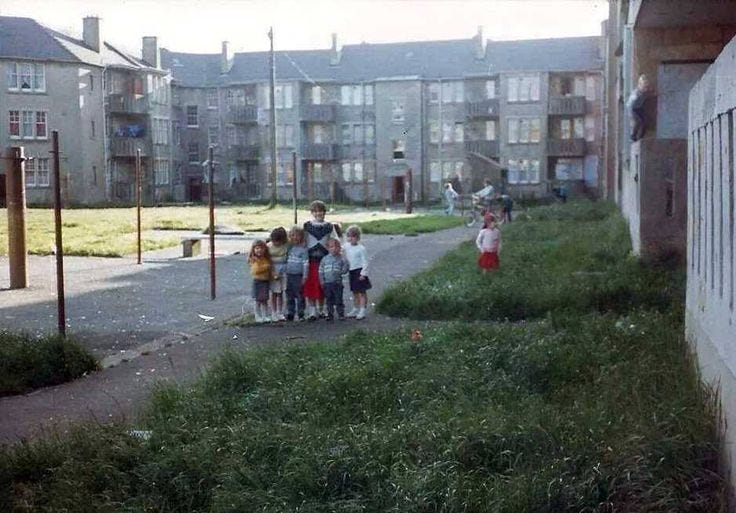
But for decades, it faced great pain and wrestled with the impacts of political choices and economic circumstances. There remain long-lasting scars on quality of life in terms of child poverty, deprivation, poor comparative health, and excess mortality (including drug-related mortality), particularly around Glasgow and the Central Belt.
We can see this in the story of Possilpark, as told through a piece published in the Pittsburgh Post-Gazette supported by the Pulitzer Center:
“Hop a cab for Possilpark, and the cabbie inevitably raises his eyebrows, then lets you know he’s collected many a fare delivering drug seekers to its low-income housing complexes with nicknames like The Jungle. The road to The Jungle will seem familiar to Pittsburghers.
Around 150 years ago, Possilpark changed rapidly from farmland to factories when a new railway attracted the Saracen Foundry ironworks. In 20 years, Possilpark’s population exploded from 10 to 10,000 (where it remains), as housing, schools, cinemas and shops followed the jobs at the foundry and its spinoff factories.
The foundry closed in 1967, leaving vast brownfields and few jobs. By the 1980s the neighborhood was the hub of Glasgow’s heroin trade. A sports facility dubbed the Millennium Centre failed, was vandalized and burned. Now the shopping artery of Saracen Street features pubs, bookies and a pharmacy that draws a morning queue of methadone users.
Studies show that Glasgow’s Canal Ward, which includes Possilpark, has been the most persistently deprived area in the United Kingdom, which includes England, Scotland, Wales and Northern Ireland…
The Jungle isn’t as wild as it used to be. The fleetols now rarely square off with police, and the heroin trade is less public. But knife crime is prevalent, and people are dropping from “street valium” — black market narcotics pressed into pills, and sometimes taken in combination with heroin or methadone. Glasgow’s fatal overdose rate has spiked to rival Allegheny County’s in 2017, when fentanyl drove record deaths.”
This experience is not unique. We have already witnessed similar circumstances in Canada in many communities, particularly in already hard hit regions in Southwestern Ontario, mill and mining towns in the North, or other industry towns and cities across the country. Without deliberate action, we risk a similar pattern: sudden job loss, long-term health impacts, derelict land, and a political backlash that fuels separatism and populism.
In the next part of the series, I will look more fully at how Scotland compares to Canada. Comments and questions welcome.